> ## Documentation Index
> Fetch the complete documentation index at: https://docs.getlago.com/llms.txt
> Use this file to discover all available pages before exploring further.
# MAX
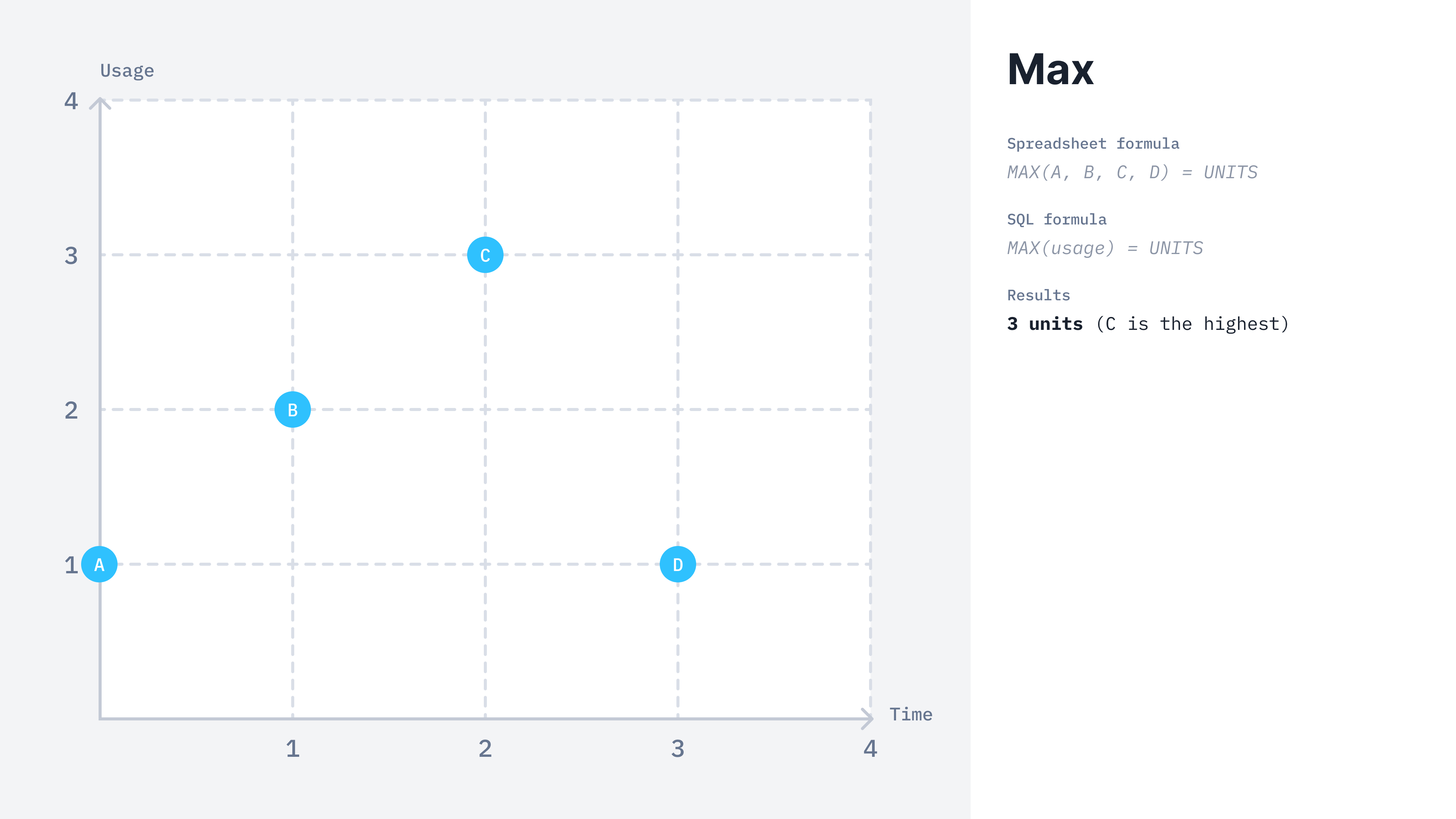
The max aggregation type selects the highest value of a specified event property from all received events.
 ## MAX billable metric
Here is how you can create a max aggregation from the UI:
1. Access the **"Billable metrics"** section via the side menu;
2. Create a new billable metric;
3. Define a name, a code and an optional description;
4. Select **"max"** as the aggregation type;
5. Define the property to aggregate;
6. Apply dimension groups if any; and
7. Click **"Add billable metric"**.
This billable metric is `metered` only, meaning it cannot be recurring, and the number of billing units resets to 0 at the end of each period.
```bash theme={"dark"}
LAGO_URL="https://api.getlago.com"
API_KEY="__YOUR_API_KEY__"
curl --location --request POST "$LAGO_URL/api/v1/billable_metrics" \
--header "Authorization: Bearer $API_KEY" \
--header 'Content-Type: application/json' \
--data-raw '{
"billable_metric": {
"name": "API Request",
"code": "api_requests",
"description": "Number of API requests.",
"aggregation_type": "max_agg",
"field_name": "total_requests",
"group": {}
}
}'
```
## Calculation example
Lago calculates the `MAX(events.properties.property_name)` for the two following events received.
```json theme={"dark"}
//Event received #1
{
"transaction_id": "transaction_1",
"external_customer_id": "1",
"timestamp": "2022-03-16T00:00:00Z",
"code": "api_requests",
"properties": {
"total_requests": 20
}
}
//Event received #2
{
"transaction_id": "transaction_2",
"external_customer_id": "1",
"timestamp": "2022-03-17T00:00:00Z",
"code": "api_requests",
"properties": {
"total_requests": 10
}
}
```
In that case, with this aggregation type, Lago takes the highest value of `total_requests` property from all events, **resulting in a billable value of 20 units.**
## MAX billable metric
Here is how you can create a max aggregation from the UI:
1. Access the **"Billable metrics"** section via the side menu;
2. Create a new billable metric;
3. Define a name, a code and an optional description;
4. Select **"max"** as the aggregation type;
5. Define the property to aggregate;
6. Apply dimension groups if any; and
7. Click **"Add billable metric"**.
This billable metric is `metered` only, meaning it cannot be recurring, and the number of billing units resets to 0 at the end of each period.
```bash theme={"dark"}
LAGO_URL="https://api.getlago.com"
API_KEY="__YOUR_API_KEY__"
curl --location --request POST "$LAGO_URL/api/v1/billable_metrics" \
--header "Authorization: Bearer $API_KEY" \
--header 'Content-Type: application/json' \
--data-raw '{
"billable_metric": {
"name": "API Request",
"code": "api_requests",
"description": "Number of API requests.",
"aggregation_type": "max_agg",
"field_name": "total_requests",
"group": {}
}
}'
```
## Calculation example
Lago calculates the `MAX(events.properties.property_name)` for the two following events received.
```json theme={"dark"}
//Event received #1
{
"transaction_id": "transaction_1",
"external_customer_id": "1",
"timestamp": "2022-03-16T00:00:00Z",
"code": "api_requests",
"properties": {
"total_requests": 20
}
}
//Event received #2
{
"transaction_id": "transaction_2",
"external_customer_id": "1",
"timestamp": "2022-03-17T00:00:00Z",
"code": "api_requests",
"properties": {
"total_requests": 10
}
}
```
In that case, with this aggregation type, Lago takes the highest value of `total_requests` property from all events, **resulting in a billable value of 20 units.**