> ## Documentation Index
> Fetch the complete documentation index at: https://docs.getlago.com/llms.txt
> Use this file to discover all available pages before exploring further.
# Percentage
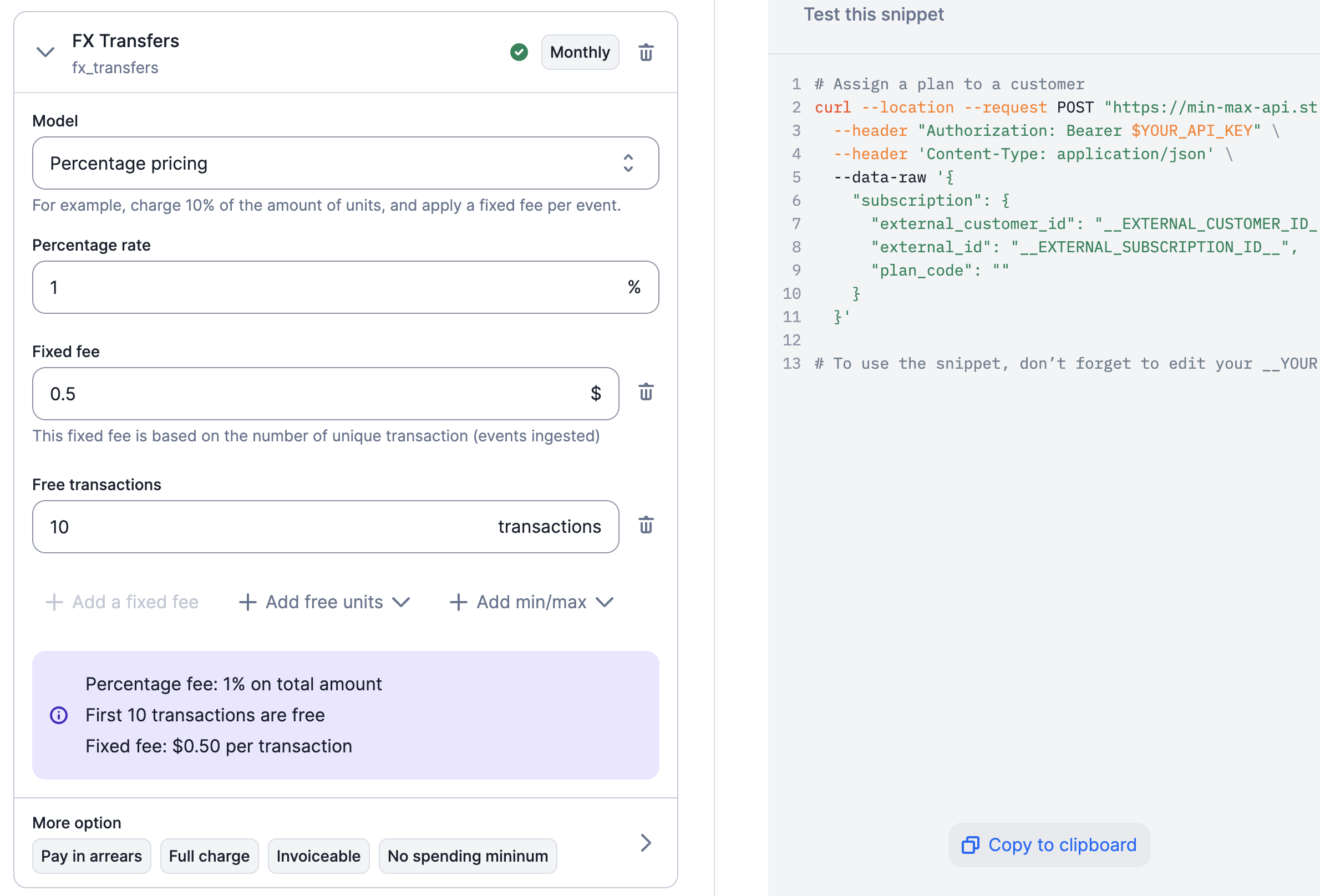
Select the percentage charge model if you want to apply a **percentage and a
fixed fee on transactions** (e.g. bank transfers, ATM withdrawals, etc.).
This charge model is generally used with billable metrics that allow users to
calculate the total amount of transactions (e.g. `sum` aggregation type and
`amount` defined as the event property -
[learn more](/guide/billable-metrics/aggregation-types)).
You can define several parameters for the percentage charge model, including:
* **Percentage rate**: charge rate that applies to the total amount (e.g. 1.2%
on transactions);
* **Fixed fee (optional)**: fee that applies to each event ingested during the
billing period (e.g. \$0.10 per transaction);
* **Free units (per event - optional)**: number of events that are not subject to
the fixed fee;
* **Free units (total amount - optional)**: amount that is not subject to the
charge rate;
* **Per-transaction spending minimum (per event - optional)**: sets the minimum amount of spending required for each individual transaction; and
* **Per-transaction spending maximum (per event - optional)**: sets the maximum amount of spending required for each individual transaction.
When free units are defined for both the total amount and number of events, Lago
performs checks each time a new event is ingested to determine whether the free
units still apply. In the illustration below for instance, the first 3 events or
\$500 are free.
**Premium feature ✨**: only users with a premium license can define a per-transaction spending minimum and maximum for the percentage pricing model.
Please **[contact us](mailto:hello@getlago.com)** to get access to Lago Cloud and Lago Self-Hosted Premium.
 Consider the following list of events:
| Event | Amount | Total number of events | Total amount | Result |
| ------------- | ------ | ------------------------------ | ------------------ | ---------- |
| Transaction 1 | \$200 | 1 free event (out of 3) | \$200 (\$500 free) | No charges |
| Transaction 2 | \$100 | 2 free events (out of 3) | \$300 (\$500 free) | No charges |
| Transaction 3 | \$100 | 3 free events (out of 3) | \$400 (\$500 free) | No charges |
| Transaction 4 | \$50 | 4 events (free units exceeded) | \$450 (\$500 free) | Charge |
Therefore, for the fourth transaction, the charge will be \$0.10 x 1 event + 1.2%
of \$50 = \$0.70.
Consider the following list of events:
| Event | Amount | Total number of events | Total amount | Result |
| ------------- | ------ | ------------------------------ | ------------------ | ---------- |
| Transaction 1 | \$200 | 1 free event (out of 3) | \$200 (\$500 free) | No charges |
| Transaction 2 | \$100 | 2 free events (out of 3) | \$300 (\$500 free) | No charges |
| Transaction 3 | \$100 | 3 free events (out of 3) | \$400 (\$500 free) | No charges |
| Transaction 4 | \$50 | 4 events (free units exceeded) | \$450 (\$500 free) | Charge |
Therefore, for the fourth transaction, the charge will be \$0.10 x 1 event + 1.2%
of \$50 = \$0.70.