

PREMIUM FEATURE ✨Forecasted Usage and advanced filtering options are only available to users with a premium license. Please
contact us to get access to Lago Cloud and Lago
Self-Hosted Premium.
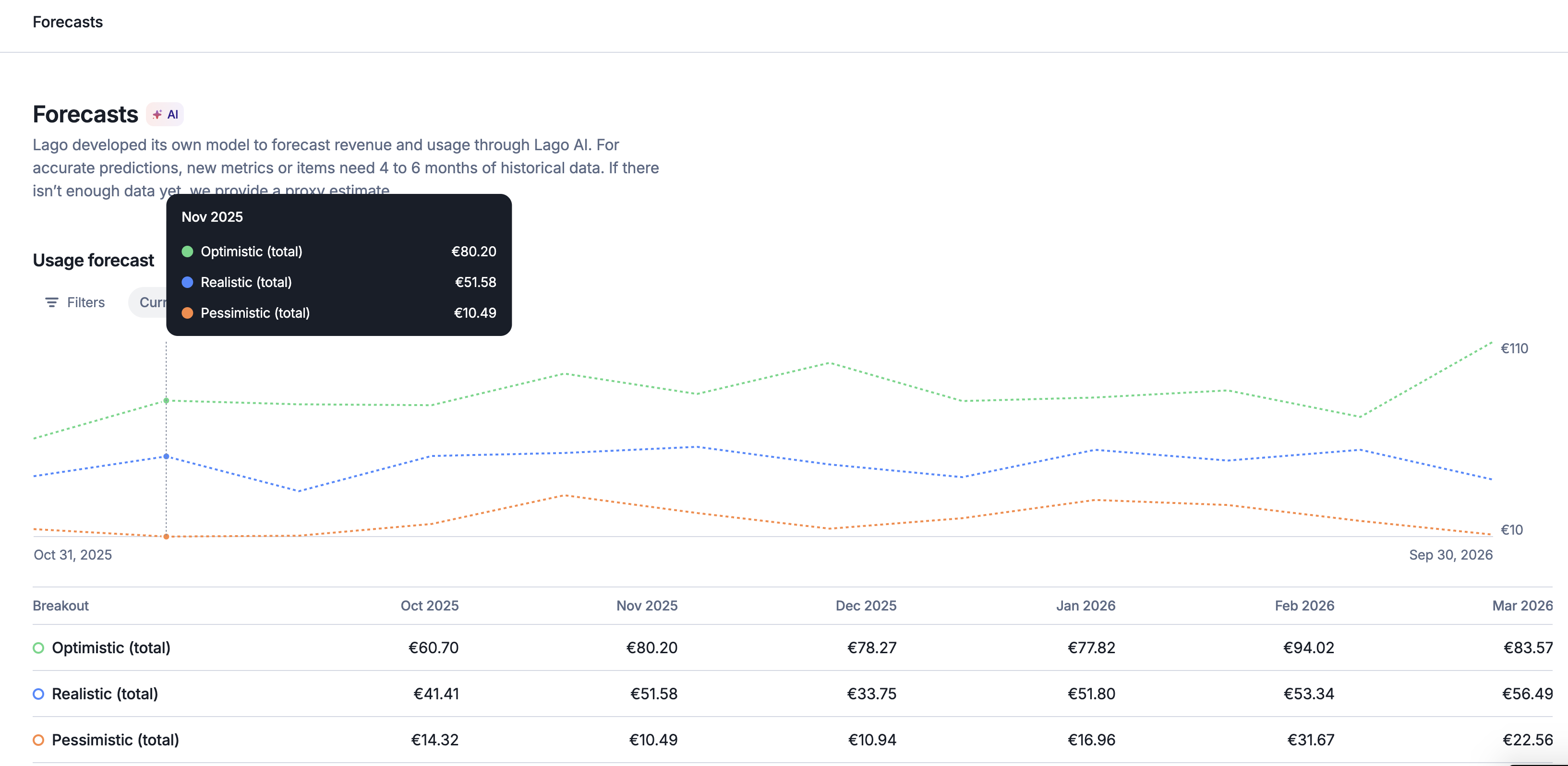
Forecasted usage dashboard
What’s on this dashboard
Two charts. Both are activity: each value covers the month it sits in. The forecast runs 12 months ahead, one value per month.The three scenarios
Every forecast comes in three versions, so you can plan against a range rather than a single number.What is being forecast
Filters
⚠️ There is no date range here. The horizon is always the next 12 months.
What’s not included (for now)
- New products and features. The forecast is built from what your customers already consume.
- Recently created metrics and charges. They may be left out until they have enough history.
- Unused or deleted metrics and charges. They may be left out too.
- Anything other than usage. Subscription revenue is on MRR, invoiced revenue on Revenue streams.
Common questions
Why don't I see any forecast?
Why don't I see any forecast?
Forecasting needs at least six months of consumption history to produce something reliable. If your organization has less than that, forecasts appear once enough history has built up.
How often does the forecast change?
How often does the forecast change?
It is refreshed once a month, usually during the first two weeks. It does not move day to day like the other reports.
Which number should I put in the board pack?
Which number should I put in the board pack?
The realistic scenario, and quote the conservative one next to it as your floor. Quoting the optimistic figure alone will overstate the case.
A big metric is missing from the forecast.
A big metric is missing from the forecast.
It is probably too new, or it has been unused or deleted. Metrics and charges without enough recent history can be left out. Check its consumption on Usage.