

Wallets & creditsInvoicingTaxes
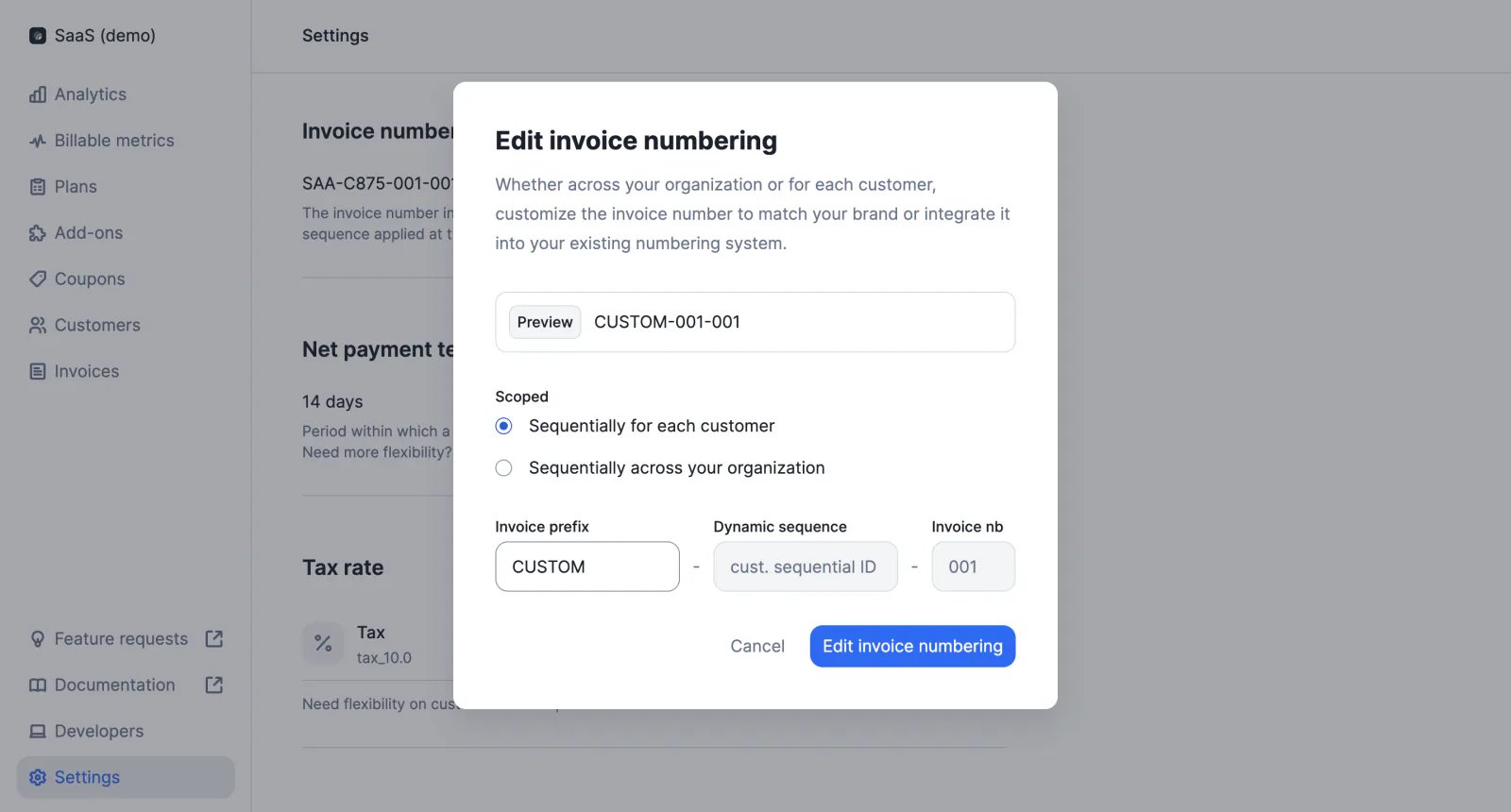
Custom invoice numbering
We have made invoice numbering more flexible, with three elements:- Prefix that can be customized
- Dynamic sequence, either based on sequential customer IDs, or based on year and month (i.e. YYYYMM)
- Sequential number of the invoice (i.e. 001, 002, 003, etc.)
EU tax management
Lago’s EU tax detection feature allows users to check customers’ tax identification numbers through integration with the European VAT Information Exchange System (VIES), and to automatically assign them a tax rate based on their country.Learn more
Unit prices
PDF invoices now include details of charges for each pricing model (e.g. for graduated pricing, we display the number of units and unit price for each tier).This information is also available in the invoice object (seeinvoice.fees.amount_details).Learn more
Automatic wallet top-ups ✨
✨ This feature is only available to users with a premium license. Please contact hello@getlago.com to get access to Lago Cloud and Lago Self-Hosted Premium.
- Based on a time interval (e.g. weekly, monthly, etc.)
- Based on a threshold (e.g. when the wallet balance is less than or equal to $10)

PaymentsUsage & meteringAPI
Event validations
We have added anevents.errors webhook message to notify users when some of the events ingested in the last hour are invalid.Possible errors include:- Invalid billable metric code
- Missing aggregation property
- Missing group key
Regenerate checkout links
When a customer wants to update their payment method, or when a checkout link has expired, users can generate a new checkout URL on demand through the Lago API.This action is available for all our native payment integrations.Learn moreCustom success URL
When setting up one of our native payment integrations, users can define the URL to which customers should be redirected after completing the checkout process. Custom URLs can only be added via the user interface.Learn more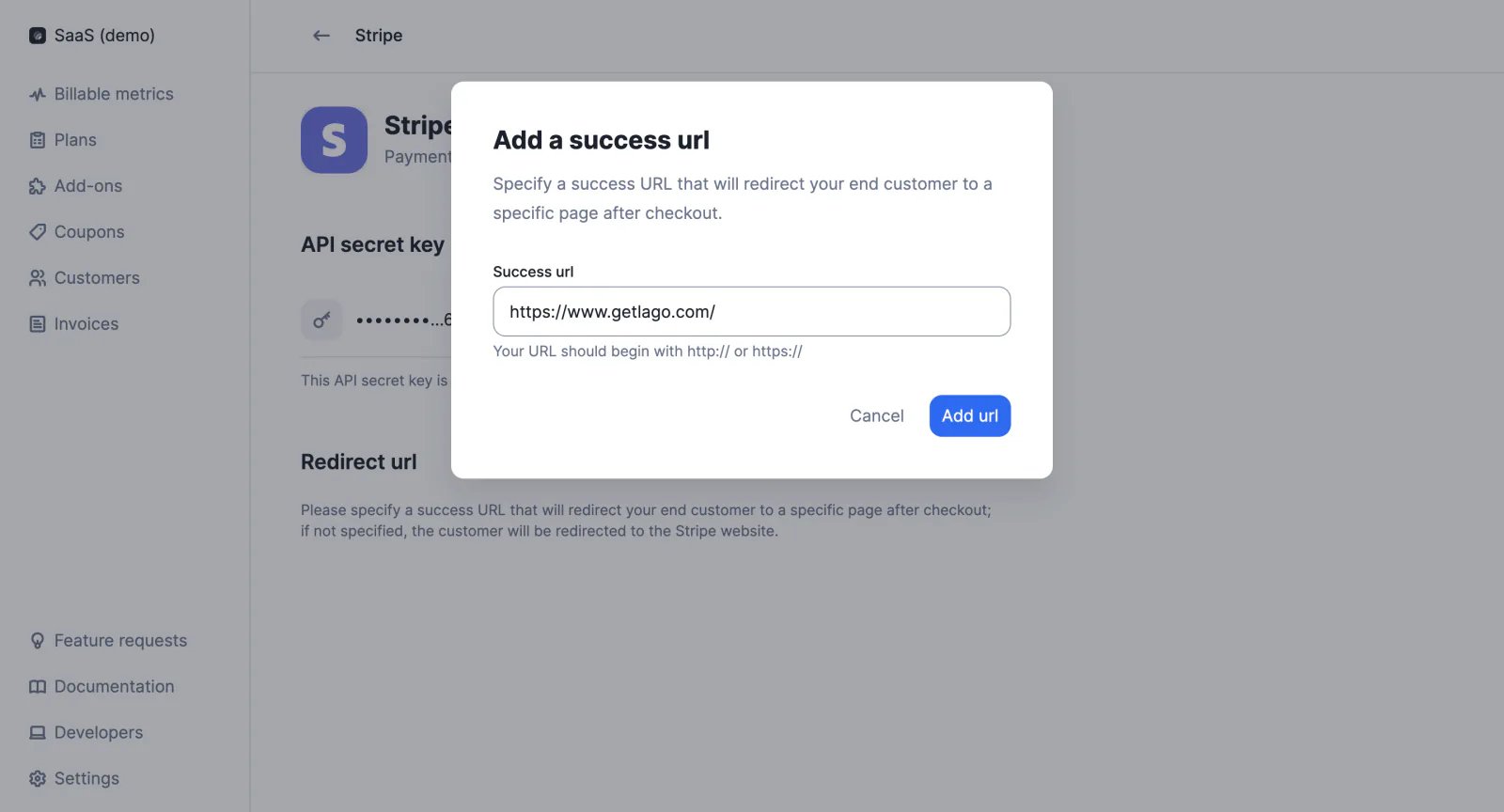
Default currency
The organization’s currency can be defined in the settings of the account or via API. It is used as the default currency when creating new objects, such as plans and add-ons, and to display information on dashboards.Learn more
Helm chart updates
We have released a new version of the Lago Helm Charts to facilitate on-premise deployment.Learn moreSubscriptionsUsage & meteringIntegrationsInvoicing
Integration with Salesforce CRM ✨
✨ This feature is only available via a paying add-on. Please contact hello@getlago.com to get access to the Salesforce CRM integration.
Removal of event validations
We are currently upgrading our infrastructure and setting up a new event ingestion system. As part of this project, we have decided to remove the validations that were automatically performed when ingesting events through the Lago API.This means that the API no longer returns error messages when events include incorrect parameters (e.g. wrong billable metric code, subscription not found,transaction_id already exists, etc.).Retrieve a subscription
We have added a new endpoint to allow users to retrieve a specific subscription via the Lago API, using theexternal_id of the subscription.Learn moreWebhooks for subscription upgrades/downgrades
When the plan associated with a subscription changes, Lago automatically notifies the user with two webhook messages:subscription.terminatedto confirm the termination of the initial plan (includesnext_plan_code)subscription.startedto confirm the start of the new plan (includesprevious_plan_code)
Plan details
In the Plans section of the app, users can now click one of their plans to see its details (i.e. name, code, interval, currency, subscription fee, usage-based charges, etc.) and also retrieve the list of subscriptions linked to the plan.In addition, in the customer view of the app, users can click one of the subscriptions assigned to their customer to see its details (i.e. status, start date, interval, currency, fees, charges, etc.).
Override plans ✨
✨ This feature is only available to users with a premium license. Please contact hello@getlago.com to get access to Lago Cloud and Lago Self-Hosted Premium.
- Currency
- Subscription fee
- Charge prices
- Minimum spending requirements
- Tax rates
- Invoice display names

Spanish locale
¡Hola a todos! The Spanish locale is now available on Lago.Users can select it as their organization’s default language or as a customer’s preferred language.Learn moreSwedish locale
Hej alla! The Swedish locale is now available on Lago.Users can select it as their organization’s default language or as a customer’s preferred language.Learn moreDisplay names on invoices
When creating or updating a plan, users can define custom display names for subscription and usage-based charges, which will be printed on the PDF files generated by Lago.Display names can be defined via the user interface or the API (seeplan.invoice_display_name and charges.invoice_display_name).Learn more
Retrieve past usage
We have added a new endpoint to retrieve past usage. When a billing period has ended, users can still retrieve usage data throughGET /customers/{external_customer_id}/past_usage.Users must specify external_subscription_id and can filter results by billable_metric_code. They can also select the number of past periods for which they wish to retrieve usage data.Learn moreUsage & meteringSubscriptions
LATEST aggregation
latest_agg allows users to compute usage based on the last value received during the period for a billable metric.Consider the following example for the storage metric, where usage is aggregated based on the property gb:- The first event includes 5 GB
- The second event includes 7 GB
- The third event includes 6 GB
latest_agg, at the end of the billing period, the total number of units used to calculate the fee will be 6, as it’s the last value received.Learn more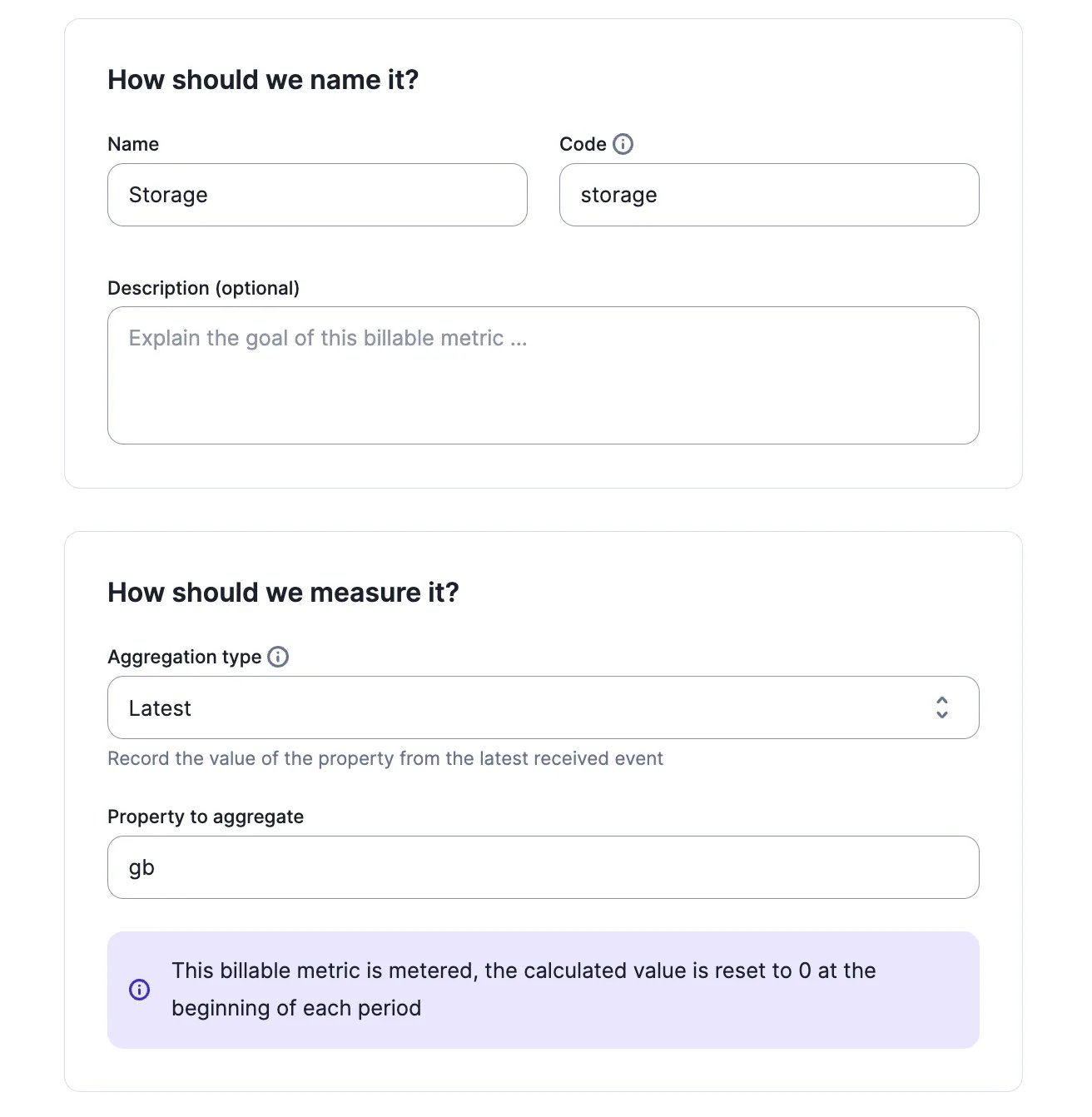
WEIGHTED SUM aggregation
weighted_sum_agg allows users to compute usage based on a custom property and the time elapsed between two events (e.g. memory consumption measured in GB-seconds).Billable metrics based on this aggregation type can be metered or recurring, and are always billed at the end of the billing period.Learn moreSubscription end date
When a subscription end date is set, the subscription is automatically terminated by Lago.A notification is sent to the user 45 days and 15 days before the subscription is terminated (seesubscription.termination_alert webhook).If no end date is set for a subscription, it will renew automatically.Learn moreDuplicate plans
Users can duplicate an existing plan from the user interface to create a new plan with the same structure. They can then choose a name and a code for their new plan, and modify the parameters that differ from the original plan (e.g. interval, currency, charges, etc.).
Edit dimensions
When dimensions are defined for a billable metric, users can add/remove groups by modifying the corresponding code snippet via the user interface, or by updating the billable metric object via API.Changes to dimensions may affect all plans where the billable metric is listed as a charge.Learn moreTaxesSubscriptionsAPIPayments
Default price for groups
For billable metrics that include several groups, when configuring their plans, users can set a default price that applies to all groups.The default price can be overwritten by setting a different price for a specific group.If the default price is not defined, it is automatically set to zero.Learn more
Italian locale
Ciao a tutti! The Italian locale is now available on Lago.Users can select it as their organization’s default language or as a customer’s preferred language.Learn moreMinimum / Maximum per transaction ✨
✨ This feature is only available to users with a premium license. Please contact hello@getlago.com to get access to Lago Cloud and Lago Self-Hosted Premium.
per_transaction_min_amount and per_transaction_max_amount parameters.Learn more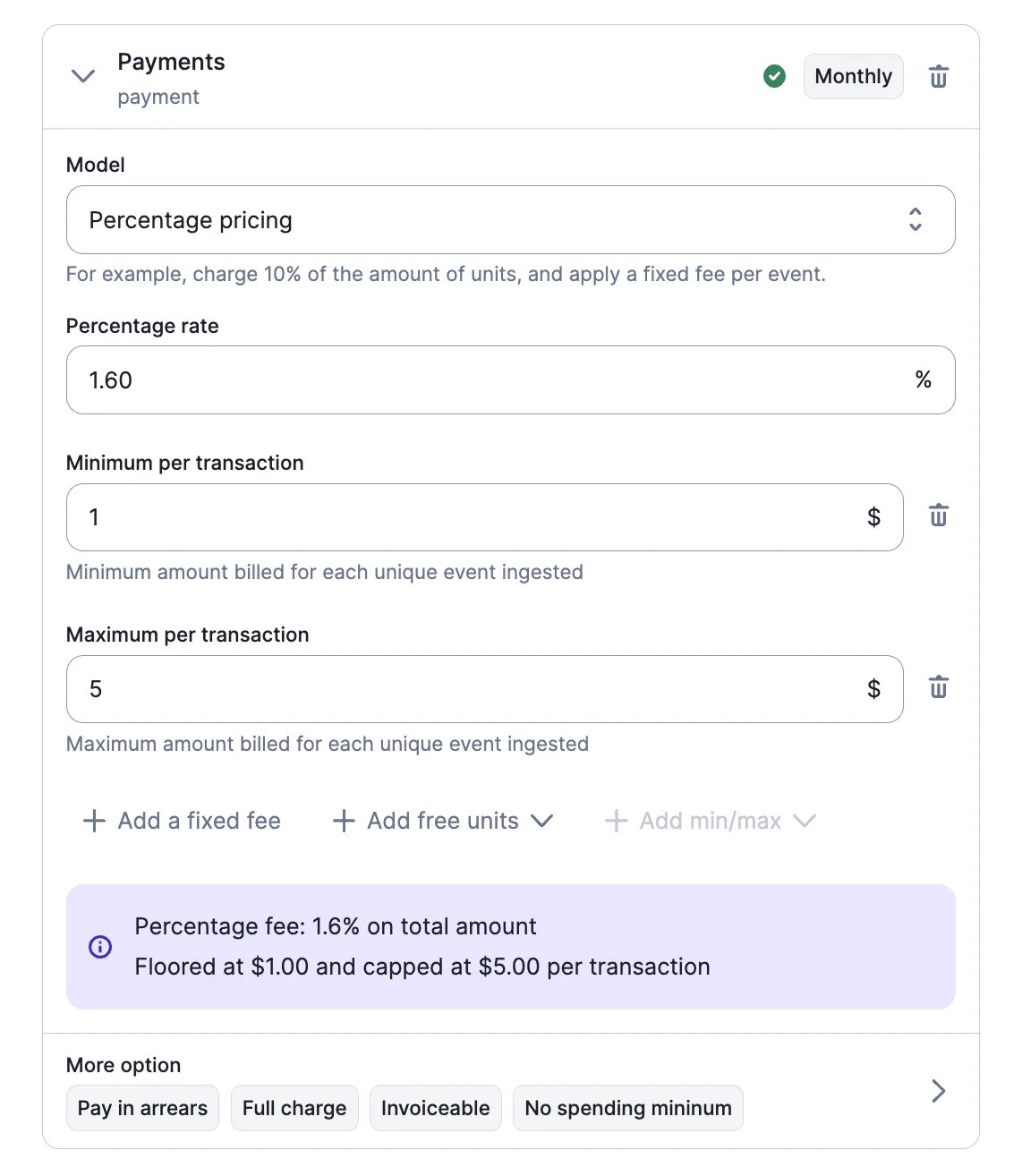
Webhook for subscriptions started
We have added a new webhook message for subscriptions.When the status of a subscription switches toactive, Lago automatically sends a subscription.started message.Learn moreGraduated percentage pricing
We have added a new graduated pricing model, which allows users to define prices based on a percentage of the number of units, and to add a flat fee for each tier (optional).Learn more
Quarterly billing interval
In addition to the weekly, monthly and yearly intervals, Lagov0.44.1-beta includes the new quarterly interval.When selected, all fees (i.e. subscription fee and charges) are billed every three months.Learn more
Webhook signatures
When creating a webhook endpoint through the user interface or the API, you can choose between:- The original
JWTsignature - The new
HMACsignature, which includes a shorter header

Taxes applied to add-ons
Tax objects can now be used to define the default tax rate(s) associated with an add-on.When creating a one-off invoice, if there is no tax rate associated with the add-on, Lago will automatically select the tax rate defined at customer or organization level.The tax rate applied to the add-on can be modified at any time through the user interface or the API.Learn more
Net payment term
The net payment term determines the number of days given to the customer to pay their invoice. It is calculated based on the date the invoice is finalized and displayed on the PDF file.When the net payment term is defined at the organization level, it applies to all customers by default. However, it can be overridden by the net payment term defined at the customer level.Learn more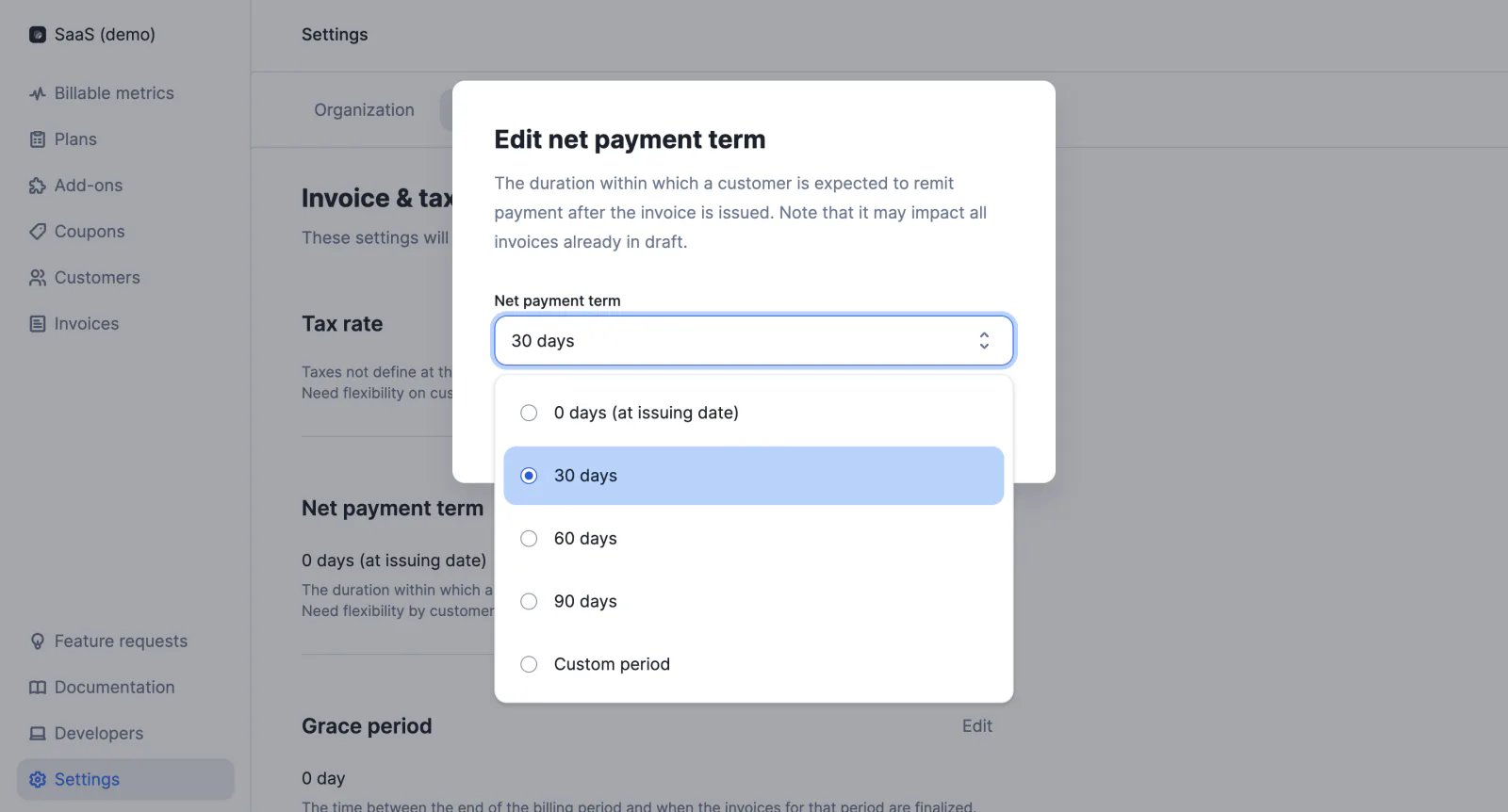
Taxes defined at plan and charge level
In addition to the taxes defined at organization and customer level, users can select tax objects at plan and charge level.For subscription invoices, the tax hierarchy is as follows:- Taxes defined at organization level will apply to all fees (i.e. subscription and charges)
- Taxes defined at customer level will take precedence over taxes defined at organization level and will apply to all fees (i.e. subscription and charges)
- Taxes defined at plan level will take precedence over taxes defined at customer level and will apply to all fees (i.e. subscription and charges)
- Taxes defined at charge level will take precedence over taxes defined at plan level but will only apply to the fee associated with the corresponding charge
PaymentsSubscriptionsTaxesAPI
Filter subscriptions by status
We have added a new query parameter to the endpoint that allows users to retrieve subscriptions.By default,GET /api/v1/subscriptions/ returns all active subscriptions. However, you can also retrieve pending, canceled and terminated subscriptions by using the status parameter.Learn moreSEPA Direct Debit with Stripe
Our native integration with Stripe now supports SEPA Direct Debit payments.When Stripe is defined as the default payment provider for a customer, you can select the authorised payment method(s): card, direct debit or both.Before initiating a payment intent, Lago will automatically check the customer’s default payment method registered in Stripe.Kindly note, SEPA Direct Debit is only available for invoices denominated in euros (EUR).Learn moreRecurring and prorated charges
When a billable metric is defined as recurring, the number of billing units at the end of the billing period is carried over to the next period. It is not reset to zero, as with metered metrics.Users can create recurring metrics based onsum_agg and count_unique_agg. They can also define whether the corresponding charges should be prorated (this option is only available for the standard and volume pricing models).ℹ️ Metrics based on
recurring_count_agg have been automatically converted into count_unique_agg metrics with the attribute "recurring": true.
Cancel pending subscriptions
When a subscription is created with a subscription date in the future, its status is automatically set topending.You can now cancel a pending subscription through the Lago API, using the following endpoint:
DELETE /api/v1/subscriptions/{external_id}?status=pendingLearn moreMultiple webhook endpoints
Webhook messages can be used to collect billing information and set up custom workflows. They are related to subscriptions, events, fees, invoices, payment providers and credit notes.You can now create up to five webhook endpoints to listen to Lago events.Learn moreCustom tax objects
In the settings of their account, users can define the default tax rate that applies by default to all customers of their organization. This tax rate can then be overwritten at the customer level.Whether set at the organization level or the customer level, so far the tax rate used to calculate fees was simply indicated as “Tax” on invoices.To give users more flexibility, we’ve added the option to create several tax objects, which can then be assigned to the organization or specific customers (e.g. state sales tax, VAT, reverse charge, GST, etc.).Learn moreStripe checkout URL
When a new customer is successfully created through Lago’s native integration with Stripe, the billing system sends acustomer.checkout_url_generated webhook message.You can redirect your customer to the corresponding page to register their payment method, which will then be used to collect payment when a new invoice is issued.Learn moreTax identification number
The customer object and organization object include a newtax_identification_number attribute. When a value is available for this attribute, it is automatically displayed on the PDF version of the next invoices.Integration with GoCardless
Lago now offers native integration with GoCardless, including (but not limited to):- Ability to define GoCardless as the default payment provider for a customer
- Ability to automatically create Lago customers in GoCardless and retrieve their customer ID
- Ability to automatically collect payments via direct debit
- Ability to automatically update the status of an invoice depending on the payment status
- Ability to automatically resubmit failed payments with GoCardless Success+
SubscriptionsUsage & meteringSecurity & access
Minimum spend on charges ✨
✨ This feature is only available to users with a premium license. Please contact hello@getlago.com to get access to Lago Cloud and Lago Self-Hosted Premium.
Coupons limited to specific metrics
We have added a new option to the coupon settings: it is now possible to limit the application scope of a coupon to specific billable metrics.By default, coupons apply to all charges but when creating a new coupon, you can define the list of billable metrics to which the coupon applies.This feature is related to thebillable_metric_codes attribute of the coupon object (see API documentation).Please refer to the guide for more information on coupons.
Reset password
You can now reset your password via the user interface.On the login page, click “Forgotten password” to access the dedicated page where you can request a link to reset your password.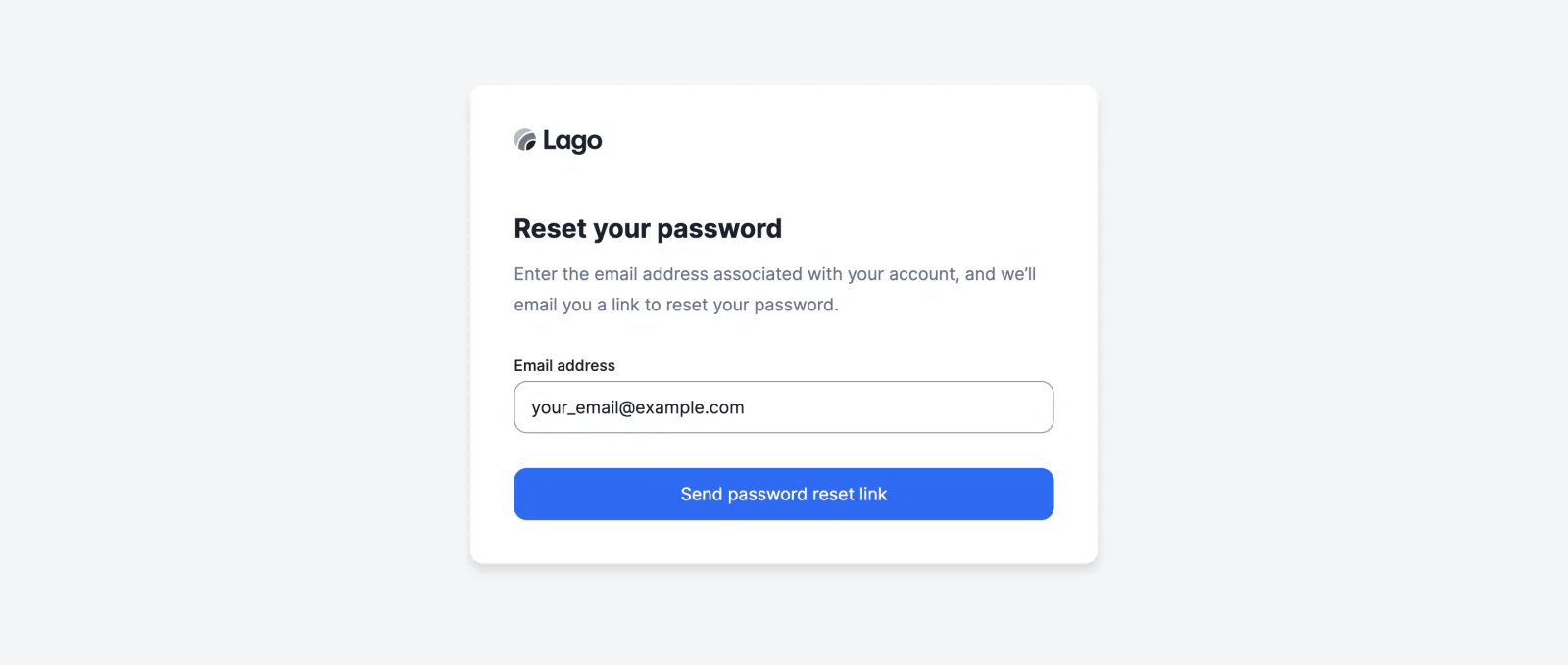
InvoicingAPICustomer portal
Automatic emails ✨
✨ This feature is only available to users with a premium license. Please contact hello@getlago.com to get access to Lago Cloud and Lago Self-Hosted Premium.
Customer billing portal ✨
✨ This feature is only available to users with a premium license. Please contact hello@getlago.com to get access to Lago Cloud and Lago Self-Hosted Premium.
Invoice metadata
After an invoice has been generated, you can add metadata to store additional information (e.g. custom ID, payment reference, etc.). This information will be included in theinvoice object but will not be displayed on the PDF invoice.Invoice metadata can be managed via the user interface or the API.Learn more
Customer metadata
When creating or editing a customer, you can add metadata to store additional information (e.g. customer type, name of the account manager, etc.).Customer metadata can be displayed on invoices, and can be managed via the user interface or the API.Learn more
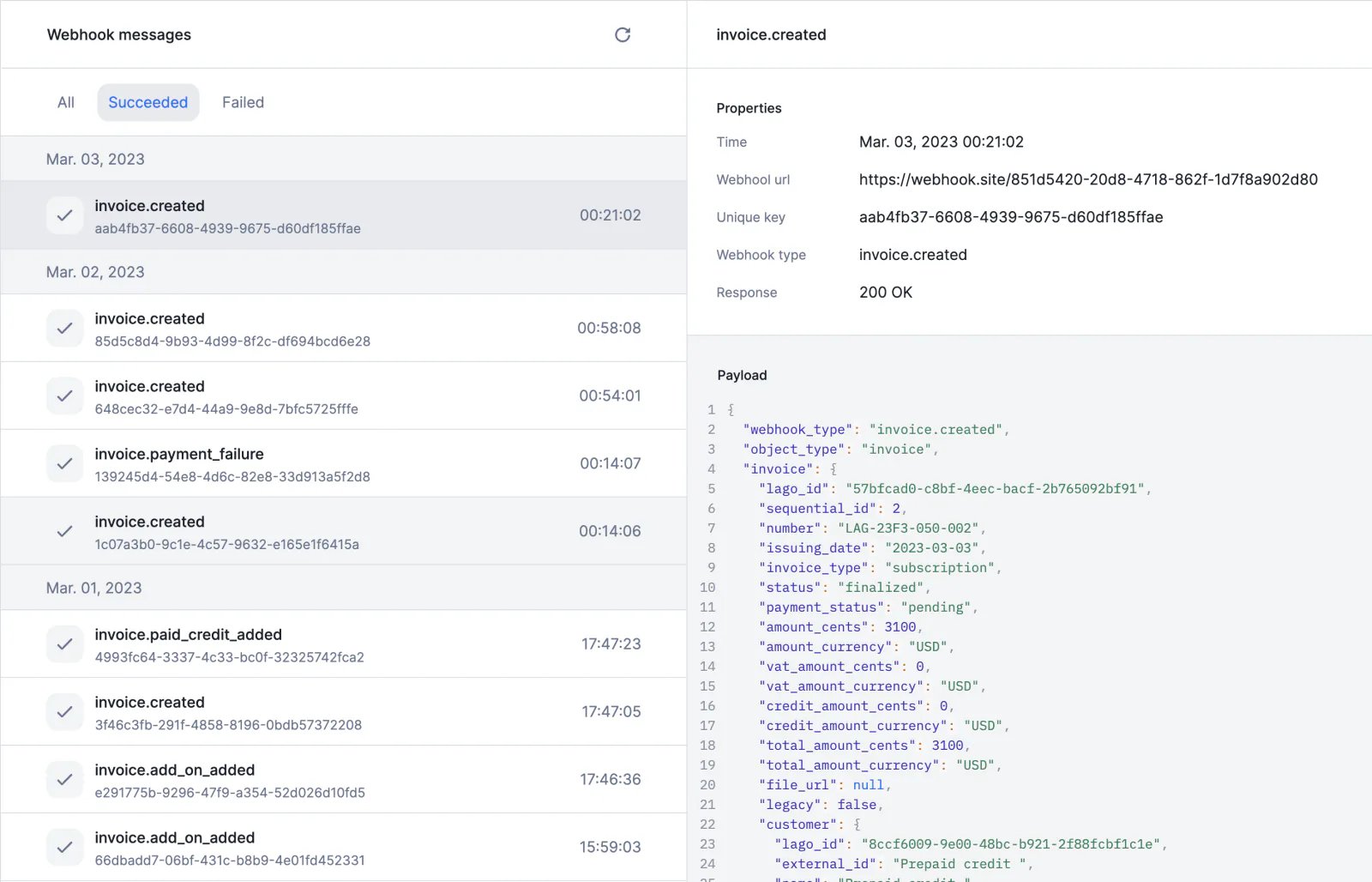
Webhook logs
The new webhook management system allows you to access the list of webhook messages sent by Lago and check their status. You can re-trigger a message that has failed through the user interface.To access the webhook logs:- Go to the Developers section via the sidebar
- Open the Webhooks tab
- Click on the webhook endpoint to see the list of messages
SubscriptionsPayments
Document translation
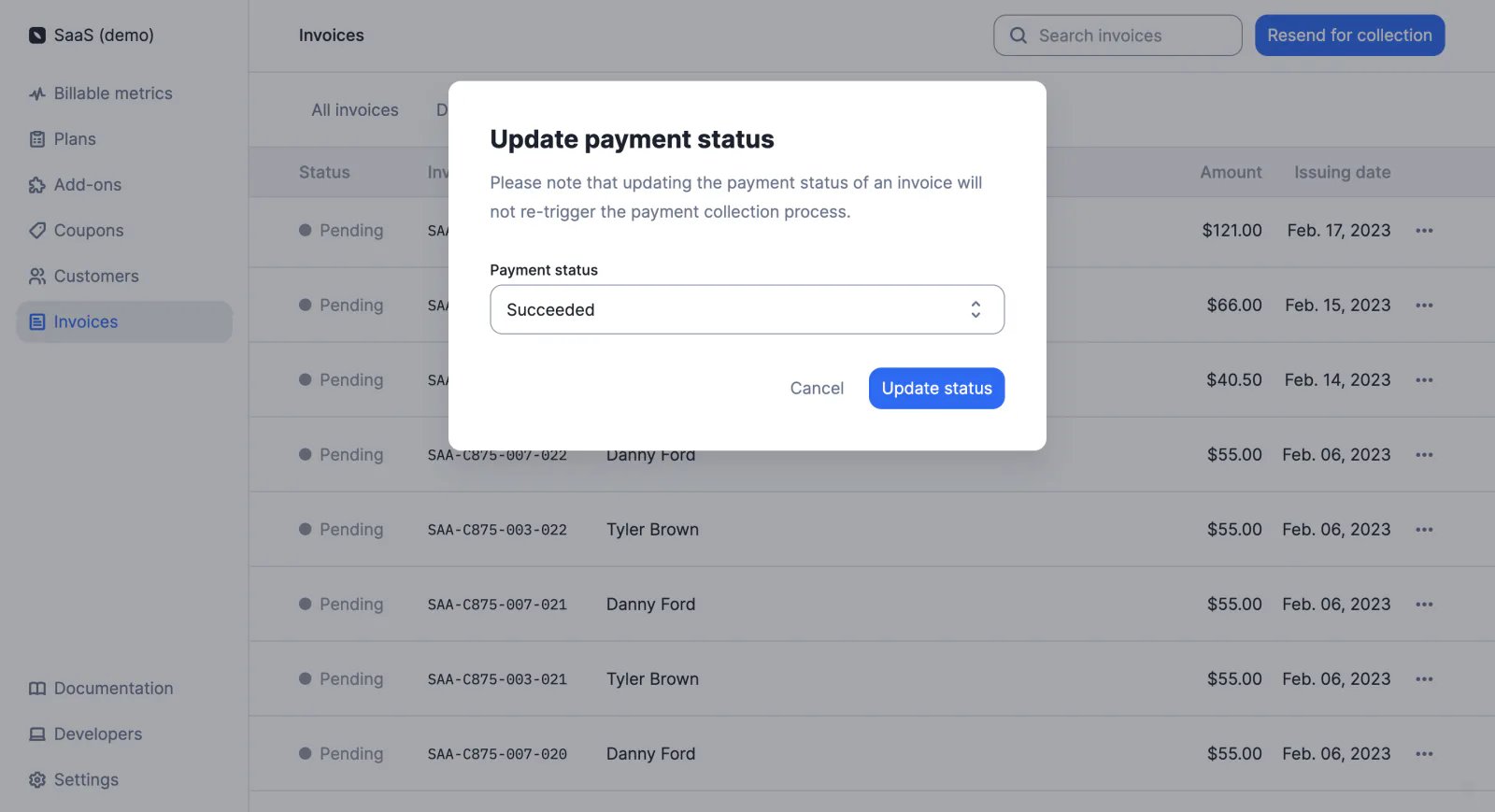
PDF files including invoices and credit notes can be generated in different languages.The default language that is set at the organization level can be overwritten by the customer’s preferred language.In the API, thedocument_locale attribute determines the language of the documents.You can contribute to Lago’s open-source project by helping us translate documents. The new language will then be added to the list of supported locales and available to the entire Lago Community.Update payment status
You can now update the payment status of an invoice through the user interface.To do so:- Access the Invoices section
- Find the relevant invoice
- Click the ellipsis icon on the right
- Click Update payment status
- Select the new payment status
- Click Update status to confirm
Coupons limited to specific plans
We have added a new option to the coupon settings: it is now possible to limit the application scope of a coupon to specific plans.By default, coupons apply to all plans but when creating a new coupon, you can define the list of plans to which the coupon applies.This feature is related to theplan_codes attribute of the coupon object (see API documentation).Please refer to the guide for more information on coupons.
InvoicingPaymentsSubscriptions
Coupons that apply forever
When creating a coupon, through the user interface or the API, it is now possible to select theforever frequency.Coupons with the forever frequency apply to all subscription invoices, regardless of the number of subscription invoices generated in a given period.ℹ️ The value of the coupon is deducted from the amount of the invoice after tax. Coupons do not apply to add-ons or any other one-off charges.

Search bar
Tired of scrolling through an endless list to find the customer your are looking for? We understand that.We have added a search functionality to the user interface to make it easier to find metrics, plans, customers, invoices, etc.
Payment retries
We have added the ability to resend payments for collection.This new feature is available to all users:- Through the user interface (learn more)
- Through the API (learn more)

Grace period ✨
✨ This feature is only available to users with a premium license. Please contact hello@getlago.com to get access to Lago Cloud and Lago Self-Hosted Premium.
draft status and can be modified. Available actions include:- Adding usage records by sending events with a
timestampwithin the relevant billing period - Applying coupons to the customer’s account
- Adding credits to the customer’s wallet and credit note wallet
finalized (they can no longer be edited), which triggers the invoice.created webhook. You can also finalize invoices manually.The organization’s grace period applies to all customers by default, but it can be overwritten by the customer’s grace period.Invoice list
We have added a new Invoices section, which allows you to access the list of invoices.Invoices are filtered according to their status (i.e. draft or finalized) and according to their payment status (i.e. succeeded, pending or failed).The same filters can be applied when retrieving invoices via the API.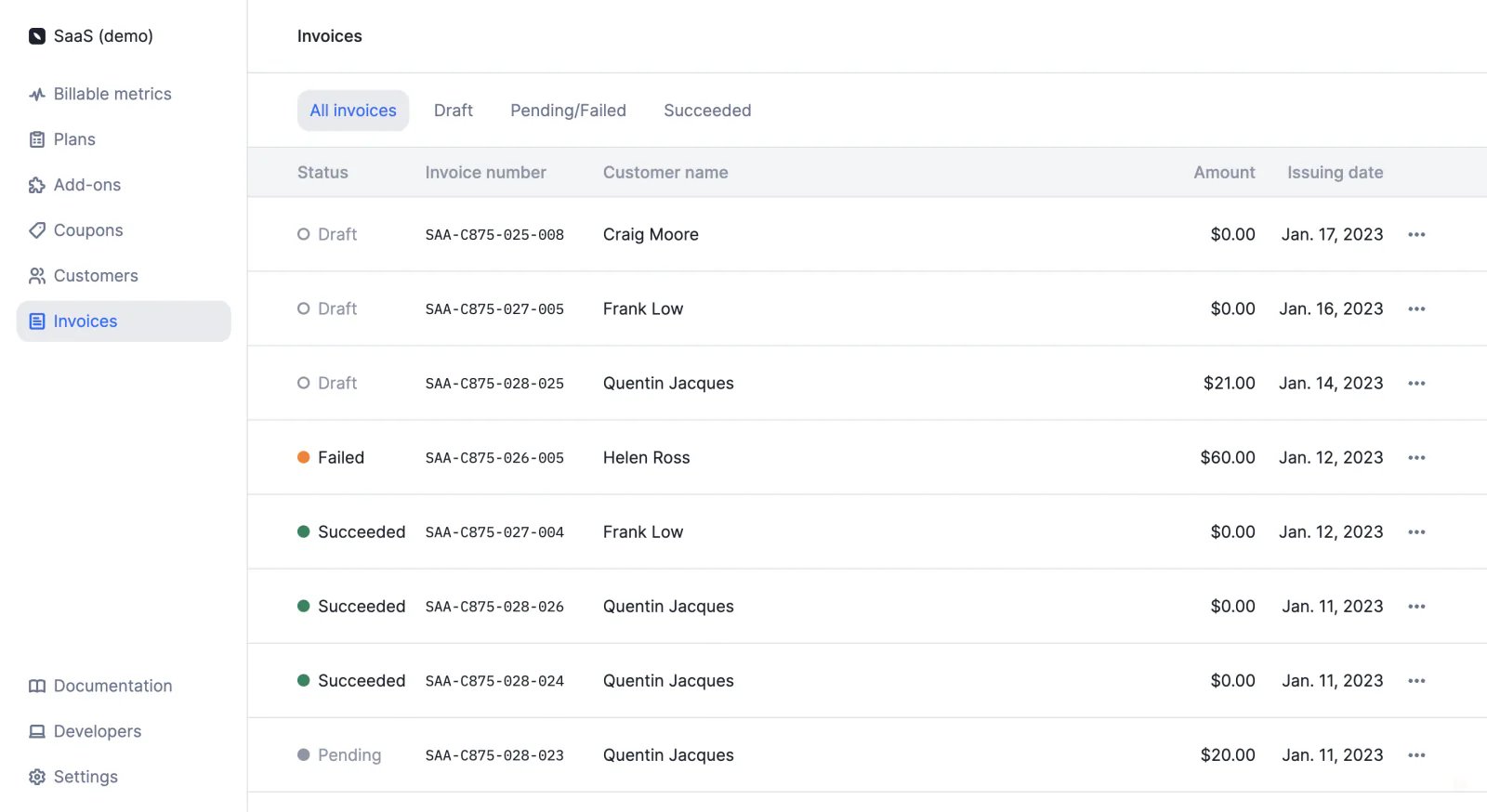
Credit notes ✨
✨ Lago may automatically generate a credit note when a subscription is upgraded or downgraded. However, only users with a premium license can manually generate credit notes via the user interface or the API. Please contact hello@getlago.com to get access to Lago Cloud and Lago Self-Hosted Premium.
- Refund the customer (only for paid invoices)
- Credit back the customer’s account
Timezones ✨
✨ This feature is only available to users with a premium license. Please contact hello@getlago.com to get access to Lago Cloud and Lago Self-Hosted Premium.
- Access the Settings section via the side menu
- In the Organization tab, you will see the current timezone (UTC by default)
- Click Edit
- Select a new timezone from the list
- Click Save timezone to confirm
ℹ️ In the app, you can hover over any date with a dotted underline to see the reference timezones.